
Why Southwest Airlines Drew the Line on Humanoid Robots
Why Southwest Airlines Drew the Line on Humanoid Robots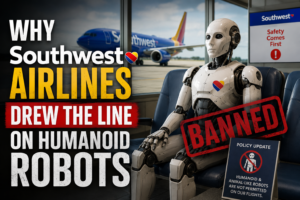
has become one of the first major U.S. carriers to explicitly ban humanoid and animal-like robots from flights, and the reason has far more to do with battery safety than science fiction fears.
The move came after a series of unusual incidents involving life-sized robots boarding commercial flights as ticketed “passengers.” One of the most talked-about cases involved a 3.5-foot humanoid robot named “Stewie,” which traveled on a Southwest flight from Las Vegas to Dallas after its owner purchased it a seat in coach. Videos of the robot moving through airport terminals and sitting by the window quickly went viral online.
Soon after, Southwest updated its policy to prohibit “human-like” and “animal-like” robots from both cabin and checked baggage transport. The airline said the primary concern was the lithium-ion batteries powering these machines.
The Real Issue: Lithium-Ion Batteries
Modern humanoid robots often rely on large, high-capacity lithium-ion battery packs. While these batteries power everything from laptops to electric cars, they also pose a known aviation risk because they can overheat and enter what experts call “thermal runaway” — a chain reaction capable of producing intense heat, smoke, and fire.
Airlines worldwide have become increasingly cautious about battery-powered devices after several high-profile incidents involving overheating power banks and electronic equipment onboard aircraft. Aviation authorities and industry groups such as the International Air Transport Association (IATA) have warned that lithium battery fires are especially dangerous in-flight because they can reignite even after being extinguished.
Southwest said the robot ban is part of a broader tightening of battery-related safety measures already being adopted across the airline industry.
When Robots Started Delaying Flights
The Stewie incident was not the only case that raised alarms.
Another robot named “Bebop,” transported by a robotics company on a Southwest flight from Oakland to San Diego, reportedly caused nearly an hour-long delay after crew members raised concerns about where it was seated and whether its battery exceeded approved aviation limits.
Although the robot owners argued the batteries were comparable to laptop batteries, Southwest ultimately decided the growing number of robot-related boarding complications created unnecessary operational and safety risks.
Why This Matters Beyond One Airline
The ban highlights a larger challenge facing the aviation industry: how to regulate increasingly advanced consumer and commercial robotics entering public spaces.
Humanoid robots are no longer confined to research labs. Companies now rent them for events, hospitality, entertainment, airport demonstrations, and customer interaction. Researchers are also rapidly advancing humanoid mobility and real-world deployment technologies.
At the same time, airports and airlines are still adapting regulations originally written long before autonomous machines became commercially accessible.
Ironically, while airlines are restricting passenger robots onboard, some aviation companies are actively exploring humanoid robots for airport ground operations such as baggage handling and cabin cleaning.
A Sign of the Future
For now, Southwest’s position is clear: humanoid robots are not welcome as passengers.
Small robotic toys and devices are still permitted if they comply with existing carry-on and battery rules, but large human-like machines are now officially grounded on Southwest flights.
The policy may sound unusual today, but it could become increasingly common as airlines confront a future where robotics, artificial intelligence, and commercial travel begin overlapping in ways regulators never anticipated.